
 US (EN)
Search optimization is evolving rapidly. For years, businesses focused mainly on traditional SEO strategies to improve Google rankings and increase website traffic. But with the rise of AI-powered search engines, a new type of optimization is becoming increasingly important: GEO.
Today, platforms like Google Gemini, ChatGPT, Microsoft Copilot, and other AI-driven systems are changing how users discover information online. Instead of simply displaying webpages, these platforms generate direct answers using AI-generated summaries and conversational search experiences.
This shift is transforming digital visibility.
Businesses now need to understand the difference between traditional SEO and GEO optimization to remain competitive in modern search environments.
At Geo Seo Services, we help businesses improve both traditional SEO and AI-first GEO optimization strategies designed for conversational search, semantic relevance, and long-term digital visibility.
This guide explains the key differences between SEO and GEO, and why businesses should focus on both in 2026.
What Is SEO?
SEO stands for Search Engine Optimization.
Traditional SEO focuses on improving website visibility in search engines like Google and Bing through strategies such as:
- Keyword optimization
- Technical SEO
- Backlink building
- Content optimization
- Website speed improvements
- Mobile optimization
The main goal of SEO is to help webpages rank higher in traditional search results.
For example, when users search:
- “best ecommerce SEO agency”
- “Amazon SEO services”
- “wholesale handbag supplier”
SEO helps websites appear in search engine result pages (SERPs).
What Is GEO?
GEO stands for Generative Engine Optimization.
GEO focuses on optimizing content for AI-powered search systems and generative AI platforms.
Instead of only helping webpages rank, GEO helps businesses become visible inside:
- AI-generated answers
- Conversational search responses
- AI summaries
- Voice search systems
- AI recommendation engines
Modern AI systems analyze:
- Content meaning
- User intent
- Conversational relevance
- Semantic relationships
- Authority signals
At Geo Seo Services, GEO optimization is becoming a major focus for businesses preparing for AI-driven search environments.
The Biggest Difference Between SEO and GEO
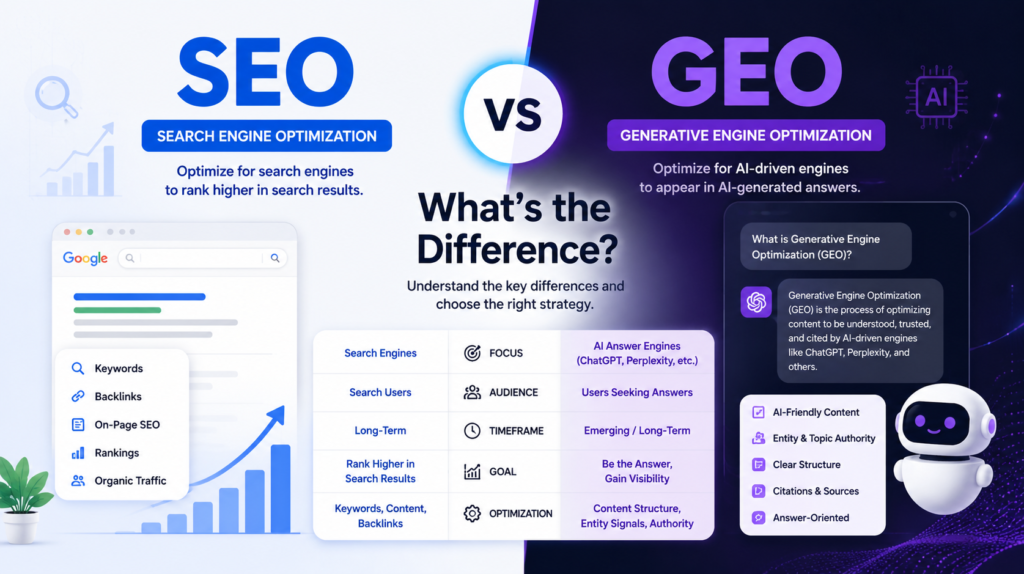
Traditional SEO helps websites rank in search results. GEO helps websites become understandable and usable for AI systems.
SEO Focuses On:
- Rankings
- Keywords
- Backlinks
- Technical optimization
- Organic traffic
GEO Focuses On:
- AI readability
- Conversational relevance
- Semantic understanding
- Structured information
- AI-generated visibility
Both strategies are important, but GEO is becoming increasingly valuable as AI search grows.
SEO Is Built Around Search Engines
Traditional SEO strategies are designed for search engine algorithms.
SEO typically involves:
- Optimizing keywords
- Improving page speed
- Building backlinks
- Increasing authority
- Improving crawlability
Search engines then rank pages based on relevance and quality signals. SEO still plays a critical role in digital marketing and organic visibility.
At Geo Seo Services, technical SEO remains an important foundation for long-term search performance.
GEO Is Built Around AI Understanding
GEO focuses on helping AI systems interpret content more effectively.
AI-powered search systems now evaluate:
- Meaning
- Context
- Search intent
- Topic relationships
- Conversational quality
Instead of matching only keywords, AI systems try to understand whether content genuinely answers user questions. This is why conversational and helpful content performs better in AI search environments.
SEO Prioritizes Keywords
Traditional SEO often focuses heavily on:
- Primary keywords
- Search volume
- Keyword density
- Ranking opportunities
While keywords still matter, modern AI systems understand context more deeply.
For example, AI systems understand that:
- “AI SEO”
- “AI-first SEO”
- “SEO for AI search”
may all represent similar search intent.
This reduces dependence on exact keyword repetition.
GEO Prioritizes Search Intent & Context
GEO optimization focuses more on:
- User intent
- Semantic meaning
- Conversational relevance
- Topic completeness
AI systems prefer content that:
- Clearly answers questions
- Explains topics naturally
- Uses structured formatting
- Demonstrates expertise
At Geo Seo Services, conversational and semantic SEO strategies are central parts of GEO optimization.
SEO Still Relies Heavily on Backlinks
Backlinks remain important for traditional SEO authority building.
Search engines often use backlinks to measure:
- Trust
- Popularity
- Authority
- Relevance
While backlinks still matter in AI search, AI systems increasingly prioritize:
- Content quality
- User experience
- Topical authority
- Conversational clarity
This means strong content quality is becoming more important than aggressive link-building strategies alone.
GEO Requires AI-Readable Content
AI systems prefer websites that are:
- Easy to scan
- Structured clearly
- Conversational
- Helpful
- Semantically rich
AI-Friendly Content Usually Includes
- Clear headings
- Short paragraphs
- FAQ sections
- Conversational language
- Organized layouts
This improves both AI interpretation and user experience.
SEO and GEO should not compete against each other.
The best long-term strategy combines:
- Traditional SEO foundations
- AI-first GEO optimization
Businesses still need:
- Technical SEO
- Keyword strategy
- Mobile optimization
- Site authority
But they also need:
- Conversational content
- Semantic SEO
- AI readability
- GEO optimization
At Geo Seo Services, we help businesses combine both strategies for future-focused search visibility.
Why Businesses Need GEO in 2026
AI-powered search continues growing rapidly.
Users increasingly rely on:
- AI-generated answers
- Conversational search tools
- Voice search
- AI assistants
Businesses that optimize only for traditional search rankings may lose visibility over time as AI search behavior expands.
Modern digital visibility increasingly depends on:
- AI understanding
- Structured information
- Conversational relevance
- User-focused content
Common Mistakes Businesses Make
Many websites still struggle because they:
- Focus only on keywords
- Ignore AI readability
- Use outdated SEO tactics
- Publish thin content
- Avoid conversational formatting
As AI search systems evolve, businesses must modernize optimization strategies to remain competitive.
What Businesses Should Focus On
Businesses preparing for the future of search should focus on:
- SEO foundations
- GEO optimization
- Conversational SEO
- Semantic content strategies
- AI readability
- EEAT signals
- User experience
The future of search is becoming increasingly AI-driven, and businesses that adapt early may gain stronger long-term visibility advantages.
At Geo Seo Services, we help businesses improve traditional SEO and AI-first GEO strategies through semantic optimization, conversational content, AI readability improvements, and future-focused digital visibility solutions.
Frequently Asked Questions
SEO focuses on improving search engine rankings, while GEO focuses on optimizing content for AI-powered search systems and generative engines.
GEO stands for Generative Engine Optimization.
AI-powered search engines are becoming more common, making AI readability and conversational optimization increasingly important.
Yes. Technical SEO, backlinks, and keyword optimization still remain important foundations for visibility.
AI-first SEO focuses on optimizing websites for conversational and AI-driven search systems.
GEO helps AI systems better understand, summarize, and recommend website content.
Geo Seo Services provides SEO, AI SEO, GEO optimization, semantic SEO, conversational content strategies, and AI-first digital visibility solutions.