

 US (EN)
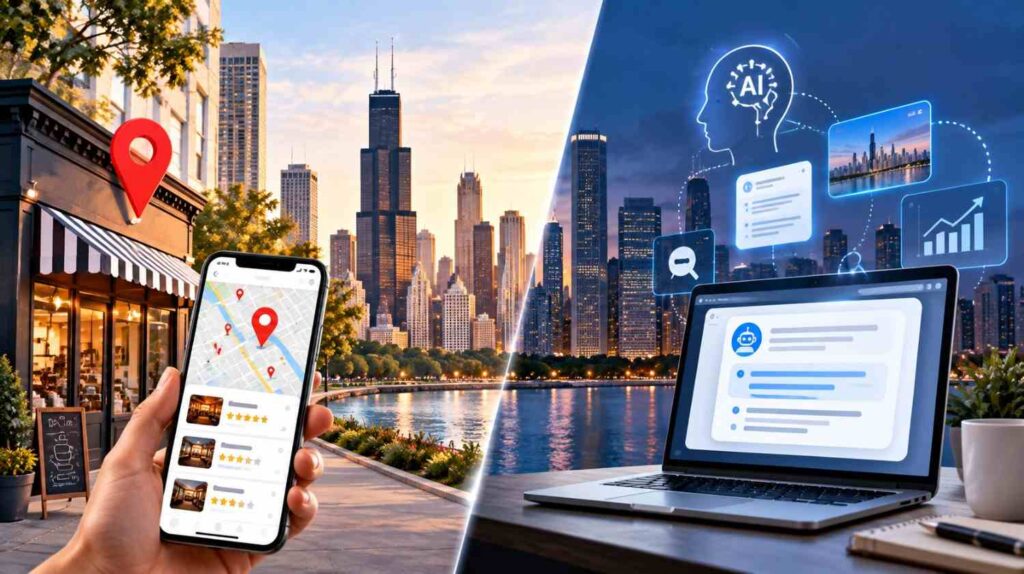
Search behavior is changing rapidly in 2026. Chicago businesses are no longer competing only for traditional Google rankings or map visibility. Customers are increasingly using conversational search and AI platforms to discover companies, compare services, ask recommendations, and find answers. This makes it important for businesses to understand the difference between Local SEO and GEO SEO, and how both can work together.
Traditional Local SEO focuses on helping a business become more visible in geographically relevant searches. GEO SEO, or Generative Engine Optimization, focuses on making business content easier for AI-powered search and answer systems to understand, retrieve, summarize, and potentially cite.
For Chicago businesses, the two approaches address different parts of the modern search journey.
What Is Local SEO?
Local SEO helps businesses appear when people search for products or services connected to a particular location. For example, searches such as “SEO agency in Chicago,” “digital marketing company near me,” or “ecommerce SEO Chicago” have strong local intent.
Google states that local search results are primarily influenced by relevance, distance, and prominence. Complete and accurate business information can help Google understand how a business relates to relevant searches.
For Chicago companies, Local SEO therefore involves maintaining accurate business information, creating useful location-focused website content, developing relevant service pages, earning authentic reviews, strengthening local authority, and ensuring that important business information is consistent across the web.
What Is GEO SEO?
GEO SEO takes optimization beyond traditional search-engine results and considers how AI-powered systems interpret and present information.
Platforms such as ChatGPT, Gemini, Perplexity, and Copilot can provide conversational answers based on information available across the web. ChatGPT Search, for example, can search the web and provide links to relevant sources, creating another way for users to discover businesses and websites.
This means businesses need content that clearly communicates who they are, what they offer, where they operate, who they serve, and why their information is useful.
GEO SEO is therefore closely connected to SEO to AI: creating content and website structures that can be clearly interpreted by AI-driven search experiences while maintaining strong traditional SEO foundations.
Local SEO vs GEO SEO: The Key Difference
The primary distinction is the search environment being optimized.
Local SEO is designed around geographically relevant search visibility, particularly traditional search results, maps, and local business discovery. GEO SEO focuses more broadly on visibility within generative and conversational search experiences.
A Chicago restaurant, for example, might use Local SEO to improve its visibility for searches such as “restaurants in downtown Chicago.” GEO SEO can complement this by developing authoritative content that clearly answers questions such as “What restaurants in Chicago offer private dining?” or “What should visitors consider when choosing a Chicago restaurant for a business dinner?”
The strongest strategy does not necessarily require choosing one approach over the other. Local SEO and GEO SEO can support the same customer journey from different directions.
Why Chicago Businesses Need Both in 2026
Chicago has a diverse business environment covering professional services, hospitality, retail, technology, healthcare, manufacturing, restaurants, real estate, and E-Commerce Marketplaces. Businesses in these sectors need to communicate both local relevance and subject-matter expertise.
Local SEO establishes geographic relevance. GEO SEO strengthens the depth, clarity, and contextual usefulness of the information available to search and AI systems.
A Chicago business can therefore create location-specific service pages, detailed FAQs, original research, comparison content, customer-focused guides, expert explanations, and supporting content marketing assets. These resources can answer the types of questions customers ask before contacting a company.
Building Content for ChatGPT, Gemini, Perplexity and Copilot
AI search optimization should begin with genuinely useful content rather than simply inserting keywords.
Businesses should clearly explain their services, locations, processes, industries, products, and customer questions. Pages should use logical headings, concise answers, descriptive page titles, appropriate structured data, internal links, and supporting evidence where relevant.
For ChatGPT specifically, OpenAI states that public websites can appear in ChatGPT Search and recommends allowing OAI-SearchBot to access content that publishers want discovered and surfaced.
This highlights an important principle: AI visibility is not just about adding the phrase “AI SEO” to a webpage. The underlying website must be accessible, understandable, useful, and supported by strong information architecture.
Combining Local SEO, GEO Services and AEO Services
A modern Chicago search strategy can bring together SEO Services, GEO Services, and AEO Services.
Local SEO can strengthen location-based discovery, while AEO focuses on providing direct answers to user questions. GEO Services extend this thinking toward generative search platforms and conversational discovery.
The content strategy should connect these disciplines instead of treating them as completely separate campaigns. A service page might target a Chicago commercial search, while its supporting FAQ answers common customer questions and its related articles provide deeper context that AI systems can interpret.
For businesses selling through online channels, E-Commerce Marketplaces should also be incorporated into the wider search strategy. Product information, category content, brand information, and educational resources can all contribute to a broader digital presence.
Content and Social Signals Matter
A company’s website should not operate in isolation. Social media marketing and content marketing can support brand visibility by distributing useful information, demonstrating expertise, and creating additional pathways through which customers discover the business.
The objective is not to publish content simply for volume. Chicago businesses should create resources that answer specific questions, explain complicated topics clearly, demonstrate experience, and provide information customers can actually use.
Over time, this creates a stronger information ecosystem around the brand.
What Chicago Businesses Should Prioritize in 2026
The practical approach is to build a strong foundation first. Ensure local business information is accurate, create genuinely useful Chicago-focused service content, strengthen technical SEO, develop question-based resources, maintain consistent business information, and make important pages accessible to search crawlers.
Then expand toward AI search by identifying questions customers ask conversationally and creating authoritative answers around those topics.
The result is a strategy that supports traditional Google discovery while preparing content for emerging AI-powered search experiences.
Final Thoughts
In 2026, Chicago businesses need to think beyond traditional rankings. Local SEO remains important for geographic discovery, while GEO SEO, AEO, and SEO to AI address the growing role of conversational and generative search.
Geo SEO Services helps businesses develop strategies combining SEO Services, GEO Services, AEO Services, Local SEO, content marketing, social media marketing, E-Commerce Marketplaces, and AI-search optimization for platforms including ChatGPT, Gemini, Perplexity, and Copilot. A coordinated approach can help businesses build a stronger and more useful digital presence across traditional and AI-powered discovery channels.
Frequently Asked Questions
Yes. Local search continues to help customers discover nearby businesses, and Google says local results are primarily influenced by relevance, distance, and prominence.
GEO SEO is an optimization approach focused on making a business’s information useful and understandable within generative search and AI-powered answer experiences.
They overlap but are not identical. AEO generally emphasizes providing direct answers to questions, while GEO focuses more broadly on visibility and representation within generative search experiences.
Yes. Local SEO can strengthen geographic discovery while GEO SEO can help a business present useful, context-rich information for AI-powered search experiences.
ChatGPT Search can retrieve information from the public web and provide links to sources. OpenAI also states that websites should not block OAI-SearchBot if they want their content to be discoverable and surfaced in ChatGPT Search.
Useful, authoritative, well-structured content can support GEO SEO by giving AI systems clearer information about a company’s expertise, services, products, locations, and answers to customer questions.
Businesses can combine SEO Services, GEO Services, AEO Services, Local SEO, content marketing, and social media marketing according to their audience, goals, industry, and existing digital presence.