

 US (EN)
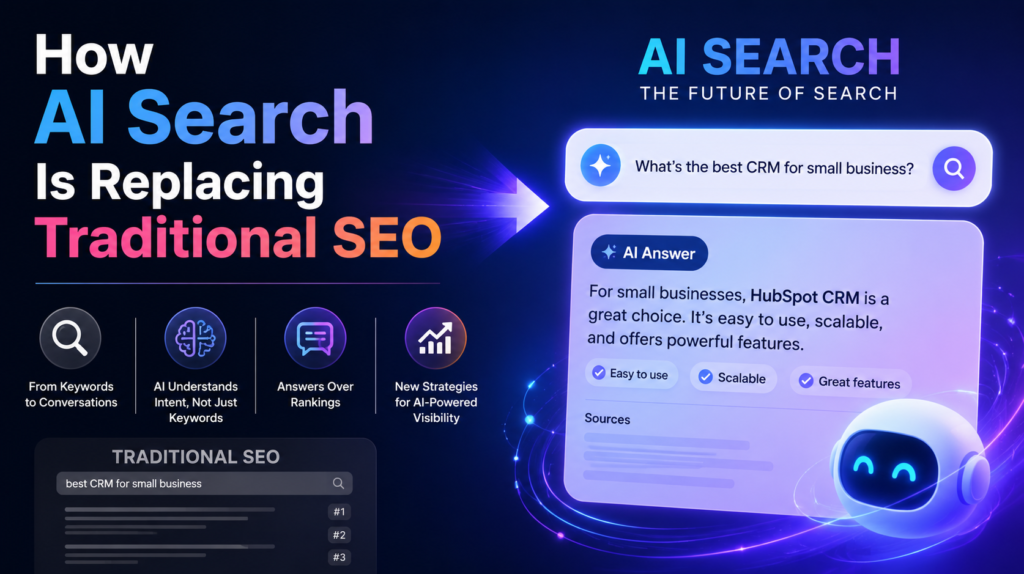
The way people search online is changing faster than ever. For years, traditional SEO focused on ranking websites through keywords, backlinks, and technical optimization. Businesses competed to appear on the first page of Google search results because users typically clicked through multiple websites to find answers.
Today, AI-powered search systems are transforming that process completely.
Modern AI search tools like Google Gemini, ChatGPT, Microsoft Copilot, and conversational AI platforms are changing how users discover information online. Instead of simply displaying webpages, these systems now generate direct answers, summaries, and recommendations in real time.
This shift is forcing businesses to rethink their entire SEO strategy.
At Geo Seo Services, we help businesses adapt to AI-first search trends through SEO, GEO optimization, AI SEO, and answer-focused content strategies designed for modern search environments.
This guide explains how AI search is changing digital visibility and why traditional SEO alone is no longer enough.
Traditional SEO Focused on Rankings
Traditional SEO strategies mainly focused on:
- Keywords
- Meta tags
- Backlinks
- Technical SEO
- Search engine rankings
The goal was simple:
Rank higher on search engines to attract clicks and website traffic.
Businesses optimized webpages around exact-match keywords hoping users would click their listings from search results. While these strategies still matter, search behavior is rapidly evolving.
AI Search Focuses on Answers
AI-powered search systems work differently from traditional search engines.
Instead of only displaying webpages, AI search tools now:
- Generate direct answers
- Summarize information
- Understand context
- Analyze user intent
- Deliver conversational responses
For example, instead of searching:
“best ecommerce SEO strategies”
users may now ask:
“How can ecommerce businesses improve SEO using AI?”
AI systems provide immediate summaries without requiring users to visit multiple websites.
This changes how businesses gain online visibility.
Search Is Becoming Conversational
Modern users increasingly search using natural language.
People now ask complete questions such as:
- “What is AI SEO?”
- “How does GEO optimization work?”
- “How can Shopify stores rank in AI search?”
AI systems are designed to understand conversational intent rather than only matching keywords.
Because of this, content written naturally and clearly is becoming more valuable than keyword-heavy content.
Keyword Stuffing Is Losing Effectiveness
Traditional SEO often encouraged excessive keyword repetition.
However, AI-powered search systems prioritize:
- Content quality
- Semantic relevance
- User experience
- Contextual understanding
Modern AI systems can understand related meanings and topic relationships without exact keyword repetition.
Helpful and informative content now performs better than robotic SEO writing.
AI Search Prioritizes User Intent
Traditional search engines focused heavily on matching search queries with optimized webpages.
AI search systems go further by analyzing:
- What users actually want
- Why they are searching
- Which answers are most helpful
This means businesses must focus on solving problems instead of only targeting keywords.
Content that genuinely answers user questions is more likely to appear in AI-generated search results.
Featured Snippets & AI Summaries Are Growing
Many users now receive answers directly within:
- AI-generated summaries
- Featured snippets
- Conversational search results
- Voice assistants
This reduces the number of traditional clicks to websites.
Businesses now compete not only for rankings but also for:
- AI visibility
- Answer engine placement
- Conversational search relevance
This is where GEO and AEO strategies become increasingly important.
GEO & AI SEO Are Replacing Old SEO Models
Generative Engine Optimization (GEO) and AI SEO focus on optimizing content for AI-driven search systems.
These strategies prioritize:
- Conversational content
- Semantic SEO
- Topical authority
- Structured formatting
- AI readability
- User-focused answers
At Geo Seo Services, we help businesses build modern search strategies designed for AI-generated search experiences rather than only traditional ranking systems.
Content Structure Matters More Than Ever
AI systems prefer content that is:
- Easy to scan
- Well-organized
- Clearly written
- Structured logically
Strong AI-friendly content usually includes:
- Clear headings
- Short paragraphs
- FAQs
- Direct answers
- Conversational formatting
Large unreadable text blocks may reduce AI understanding and user engagement.
Topical Authority Is Replacing Single-Keyword SEO
Traditional SEO often focused on optimizing individual pages for specific keywords.
AI search systems increasingly evaluate overall expertise.
Websites that consistently publish high-quality content within a niche are more likely to gain authority in AI search environments.
For example, websites covering:
- AI SEO
- GEO optimization
- Ecommerce SEO
- Conversational search
through multiple related articles may perform better than websites with isolated content.
Voice Search Is Accelerating AI Search Growth
Voice assistants continue changing how people search online.
Voice searches are usually:
- Conversational
- Question-based
- Intent-driven
Examples include:
- “What is the future of SEO?”
- “How does AI search work?”
- “Why is GEO important?”
Businesses optimizing for direct answers and conversational relevance are more likely to appear in voice search results.
The Future of Search Is AI-Driven
AI-powered search will likely continue expanding across:
- Search engines
- Ecommerce platforms
- Voice assistants
- Mobile devices
- Conversational AI tools
Businesses relying only on traditional SEO may struggle to maintain long-term visibility.
Meanwhile, businesses adopting:
- AI SEO
- GEO optimization
- AEO strategies
- Conversational content
are more likely to succeed in future search environments.
Final Thoughts
AI search is fundamentally changing how users discover information online. Traditional SEO still plays a role, but rankings alone are no longer enough.
Modern search visibility now depends on:
- Helpful content
- Conversational structure
- Semantic relevance
- User intent optimization
- AI-friendly formatting
- Topical authority
Businesses that adapt early to AI-first SEO strategies will be better positioned for the future of digital marketing.
At Geo Seo Services, we help businesses improve AI SEO, GEO optimization, answer-focused content strategies, and modern search visibility designed for evolving AI-powered search systems.
Frequently Asked Questions
AI search focuses more on direct answers, conversational relevance, and user intent instead of only webpage rankings.
Yes. Traditional SEO still matters, but businesses now also need AI-focused optimization strategies.
AI-first SEO focuses on optimizing content for AI-powered search systems and conversational search experiences.
GEO (Generative Engine Optimization) helps businesses optimize content for AI-generated search results.
AI systems better understand natural language and conversational search behavior.
No. Modern AI search systems prioritize content quality and semantic relevance over excessive keyword repetition.
Voice searches are conversational and question-focused, making answer-based optimization more important.