

 US (EN)
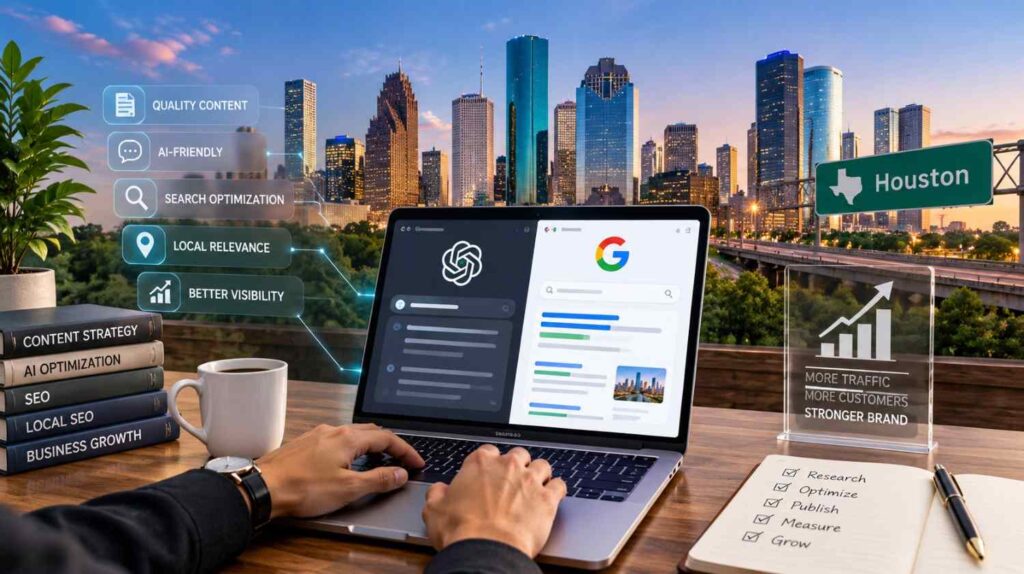
Search behavior is changing. People are increasingly using conversational AI tools to discover businesses, compare services, research products, and find answers. For Houston businesses, this means traditional search optimization should increasingly work alongside GEO Services and AEO Services.
Google has expanded its AI search features, including AI Overviews and AI Mode, while ChatGPT can search the web and provide links to relevant sources. This creates an opportunity for Houston businesses to make their websites easier for both search engines and AI systems to understand.
The goal is not simply to insert more keywords. Businesses should create useful, trustworthy, locally relevant content that clearly answers customer questions and provides enough context for search and AI systems to interpret the business accurately.
Understand What AI Search Looks For
Traditional SEO focuses heavily on helping search engines understand pages and their relevance to queries. AI-powered search adds another layer: content needs to provide clear information that can be interpreted within conversational questions.
For example, instead of creating a page that only targets “Houston SEO company,” a business could answer questions such as:
What SEO services does a Houston business need?
How can a Houston company appear in AI search results?
What is the difference between SEO and GEO?
How can local businesses optimize content for ChatGPT?
This conversational approach supports AEO Services because the content directly addresses questions users may ask.
Google’s current guidance also emphasizes that established SEO practices remain relevant for its generative AI search features. Google recommends useful, original content and highlights local, shopping, image, and video content as areas worth considering for AI search visibility.
Build Strong Houston-Focused Content
Local relevance is especially important for businesses serving Houston customers.
A Houston business should clearly communicate its service area, business location, services, industries served, and customer needs. Location-specific pages can discuss Houston neighborhoods, commercial sectors, customer behavior, and locally relevant challenges where appropriate.
For example, a digital marketing company could create useful resources about SEO for Houston restaurants, eCommerce businesses, professional services, healthcare companies, or local retailers.
This creates meaningful Local SEO signals while also giving AI systems more context about the business.
Google’s LocalBusiness structured data documentation explains that structured data can help Google understand business details such as hours, departments, and other business information.
Create Content That Answers Complete Questions
AI systems often work with natural-language questions rather than short keyword phrases. Businesses should therefore develop content around complete search journeys.
Instead of writing separate pages that repeat similar information, create comprehensive resources that explain a subject from multiple relevant angles.
For example, a Houston technology company could publish a guide covering its services, industries, common customer questions, implementation process, pricing factors, and expected deliverables.
This type of content can support SEO to AI strategies because it gives search systems a broader understanding of the company’s expertise and topical relevance.
It can also support content marketing by giving prospective customers useful information before they contact the business.
Use Clear Structure and Supporting Information
Well-organized content is easier for both people and machines to interpret.
Use descriptive headings, concise paragraphs, meaningful internal links, descriptive image information, author information where appropriate, and relevant structured data. Keep important business information consistent across the website and other trusted online sources.
Google explains that structured data helps it understand page content and can support eligible search features.
For articles, Article structured data can communicate information such as the headline, author, publication date, modification date, and images.
Structured data does not guarantee inclusion in an AI result or special search feature, but it can provide clearer machine-readable information about the page.
Optimize Content for ChatGPT
Businesses interested in appearing in ChatGPT search should ensure that important public pages are accessible to relevant crawlers.
OpenAI states that websites can appear in ChatGPT search and recommends allowing OAI-SearchBot to access content that publishers want discovered, surfaced, and cited.
This means technical accessibility should be part of a broader GEO Services strategy.
Businesses should review their robots.txt configuration, indexability, important landing pages, site architecture, internal linking, and overall content quality. A technically accessible website still needs useful content that genuinely answers users’ questions.
Create Content for Multiple AI Platforms
A strong AI search strategy should not be designed around one platform alone.
People may use chatgpt, gemini, perplexity, or copilot to research companies and services. Each platform can have different systems for retrieving and presenting information, so businesses should focus on creating authoritative, clear, accessible content rather than attempting to manipulate one specific platform.
This approach also strengthens traditional SEO because the same high-quality content can serve search engines, AI systems, and human visitors.
Connect SEO, GEO, AEO and Digital Marketing
The strongest strategy is not to treat SEO, GEO, and AEO as completely separate activities.
SEO Services can improve technical health, keyword relevance, website structure, and organic visibility. GEO Services can focus on making information discoverable and useful within generative AI experiences. AEO Services can structure content around direct questions and answers.
These efforts can work alongside Local SEO, content marketing, social media marketing, and E-Commerce Marketplaces optimization.
For Houston businesses selling products online, AI-ready product descriptions, category pages, buying guides, FAQs, reviews, product information, and supporting content can create a broader digital information ecosystem.
How Geo SEO Services Helps Businesses Prepare for AI Search
Geo SEO Services helps businesses develop strategies that connect traditional search optimization with emerging AI-powered discovery. Its approach can include SEO Services, GEO Services, AEO Services, Local SEO, content marketing, social media marketing, E-Commerce Marketplaces, and AI-search-focused content strategies.
For businesses targeting Houston as well as customers across Canada and the USA, the focus can be placed on creating location-relevant, useful, technically accessible content that communicates business expertise clearly.
As AI search continues developing, businesses should focus on building a reliable digital information foundation rather than chasing individual algorithm changes. Strong content, clear local relevance, technical accessibility, structured information, and consistent brand signals can help businesses prepare for evolving search behavior.
Frequently Asked Questions
Houston businesses can create useful, original, locally relevant content, maintain accessible webpages, answer customer questions clearly, and ensure important pages can be discovered by relevant crawlers.
GEO, or Generative Engine Optimization, focuses on improving how a brand’s information can be discovered, understood, and potentially referenced within AI-powered search and answer experiences.
Yes. Google states that SEO best practices remain relevant for its generative AI search features.
AEO, or Answer Engine Optimization, focuses on creating content that clearly addresses questions and provides concise, useful answers for search and answer-oriented experiences.
Location-specific content can help communicate geographic relevance when it provides genuinely useful information about the business, its services, customers, and local market.
Structured data helps search engines understand page information, although it does not guarantee rankings, AI citations, or enhanced search appearances.
Businesses should understand how different platforms work, but the foundation should be high-quality, accessible, clearly structured, authoritative content that serves users across multiple search environments.