

 US (EN)
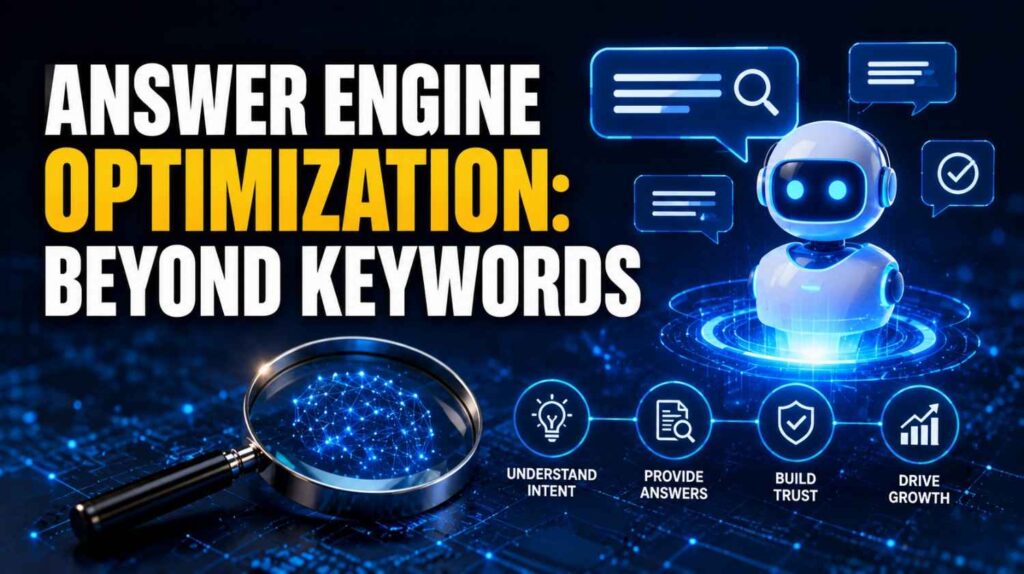
The digital search experience has evolved dramatically over the past few years. While keywords remain an important part of Search Engine Optimization (SEO), they are no longer the only factor determining online visibility. Artificial intelligence has introduced a new way for people to search, where users ask complete questions and expect immediate, conversational answers from platforms like Google AI Overviews, Microsoft Copilot, ChatGPT, Gemini, and Perplexity.
This shift has given rise to Answer Engine Optimization (AEO)—a strategy that focuses on delivering accurate, helpful, and well-structured answers instead of simply targeting keywords. Businesses that embrace AEO alongside traditional SEO and Generative Engine Optimization (GEO) are better positioned to appear in both search engine results and AI-generated responses.
For organizations across Canada and the USA, moving beyond keywords is essential for long-term digital success.
What Is Answer Engine Optimization?
Answer Engine Optimization is the process of creating and organizing website content so that search engines and AI-powered platforms can quickly identify and deliver direct answers to users.
Traditional SEO aims to improve rankings in search engine results pages, while AEO focuses on satisfying user intent by providing concise, authoritative, and relevant answers.
Instead of asking, “Which keywords should I target?” businesses should ask, “What questions are my customers trying to answer?”
This shift in thinking creates content that performs well in both traditional and AI-driven search environments.
Why Keywords Alone Are No Longer Enough
For many years, SEO strategies centered around keyword density and exact-match phrases. While keywords still help search engines understand page topics, modern AI systems evaluate much more than individual words.
They analyze context, intent, authority, content quality, and overall usefulness.
A webpage filled with keywords but lacking valuable information is less likely to appear in AI-generated answers than a well-written article that thoroughly addresses a user’s question.
Businesses that continue relying solely on keyword optimization may miss valuable opportunities as AI-powered search becomes more common.
How AI Has Changed Search Behavior
People now interact with search platforms differently than they did a few years ago.
Instead of typing “best accounting software,” users may ask, “Which accounting software is best for small businesses in Canada?”
AI-powered search engines interpret these natural language questions and generate complete responses based on trusted sources.
This change makes structured, informative content more valuable than keyword repetition.
Businesses that answer customer questions clearly improve their chances of appearing in Google AI Overviews, Microsoft Copilot, ChatGPT, and other AI search platforms.
The Role of SEO, AEO, and GEO
The strongest digital marketing strategies combine three complementary approaches.
Search Engine Optimization (SEO) ensures your website performs well in traditional search engines through technical optimization, keyword research, backlinks, and user experience.
Answer Engine Optimization (AEO) focuses on creating clear, direct responses that satisfy user intent and support featured snippets, voice search, and AI-generated answers.
Generative Engine Optimization (GEO) prepares content for AI platforms by improving structure, authority, relevance, and contextual understanding.
Together, these strategies create a comprehensive search optimization framework capable of serving both search engines and artificial intelligence systems.
Creating Content Beyond Keywords
Effective AEO begins with understanding customer needs.
Instead of producing content designed only to rank for specific terms, create articles that educate, solve problems, and provide actionable information. Use descriptive headings, conversational language, logical organization, and concise explanations throughout your content.
Include frequently asked questions, practical examples, updated statistics, and industry insights that demonstrate expertise.
Structured data further helps AI systems understand your content, while internal linking improves navigation and strengthens topic relevance.
When businesses focus on helping users first, search performance naturally improves.
Common Mistakes Businesses Should Avoid
Many organizations unknowingly limit their AI visibility by following outdated SEO practices.
Common mistakes include overusing keywords, publishing thin or duplicate content, ignoring structured data, neglecting website speed, and failing to update existing articles.
Another mistake is writing for search engines instead of people.
Modern search algorithms and AI platforms reward content that provides genuine value, demonstrates authority, and answers user questions completely.
Businesses that prioritize quality over keyword quantity consistently achieve better long-term results.
Preparing for the Future of Search
Artificial intelligence is reshaping digital marketing at an incredible pace. AI assistants are becoming trusted sources of information, while search engines continue integrating conversational experiences into their platforms.
Businesses that adopt AEO today will be better prepared for these changes.
By combining traditional SEO with Answer Engine Optimization and Generative Engine Optimization, organizations create a future-ready strategy that improves visibility across every stage of the customer journey.
Success in tomorrow’s search landscape will depend less on keyword repetition and more on providing meaningful, trustworthy answers.
Conclusion
Answer Engine Optimization represents the next evolution of digital marketing. While keywords remain valuable, they are no longer sufficient on their own. Businesses must create content that answers questions, demonstrates expertise, and supports AI-powered search experiences.
By integrating SEO, AEO, and GEO into a unified strategy, organizations can improve visibility across traditional search engines and emerging AI platforms. Moving beyond keywords enables businesses to build authority, attract qualified traffic, and achieve sustainable online growth in an increasingly AI-driven world.
Frequently Asked Questions
Answer Engine Optimization is the practice of creating content that provides clear, accurate, and direct answers for users, making it easier for search engines and AI platforms to present your information.
As AI-powered search platforms become more popular, AEO helps businesses improve visibility by aligning content with how users ask questions and how AI generates answers.
No. AEO complements traditional SEO by expanding your visibility into AI-powered search while maintaining strong performance in conventional search engines.
Keywords remain important, but AI systems also evaluate context, user intent, authority, content quality, and relevance when selecting information for responses.
Generative Engine Optimization helps AI platforms understand, trust, and reference your content, increasing the likelihood of appearing in AI-generated answers.
Yes. AEO creates conversational, question-based content that aligns well with voice search queries and AI assistants.
Geo SEO Services provides advanced SEO, AEO, and GEO solutions that help businesses move beyond traditional keyword optimization. By creating AI-ready content, implementing structured data, improving technical SEO, and optimizing websites for Google Search, Google AI Overviews, Microsoft Copilot, ChatGPT, Bing, Gemini, and Perplexity, Geo SEO Services helps businesses strengthen their digital authority and achieve sustainable online growth across Canada and the USA.