

 US (EN)
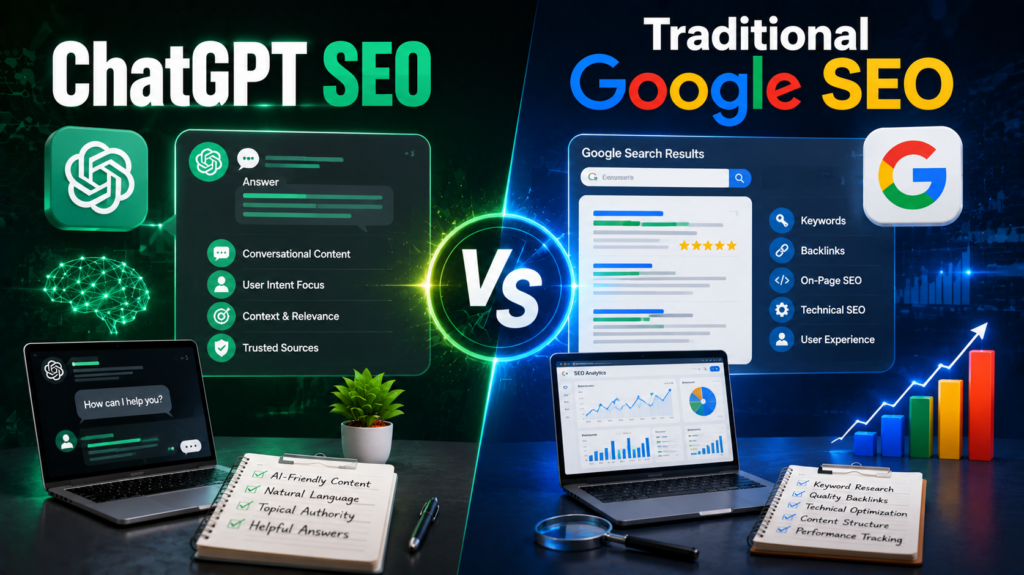
Search behavior is changing rapidly. For years, businesses focused primarily on Google SEO to improve rankings and drive website traffic. Today, AI-powered platforms like ChatGPT, Google AI Overviews, Gemini, Perplexity, and other generative search tools are changing how users discover information online.
Instead of clicking through multiple search results, users increasingly expect direct answers from AI systems. This shift has created a new optimization strategy known as ChatGPT SEO, often referred to as Generative Engine Optimization (GEO).
For businesses in Canada and the USA, understanding the differences between ChatGPT SEO and traditional Google SEO is becoming essential for long-term digital visibility.
What Is Traditional Google SEO?
Traditional Search Engine Optimization (SEO) focuses on improving a website’s visibility in search engine results pages (SERPs). The goal is to rank higher for relevant keywords and attract organic traffic.
Google SEO typically involves:
- Keyword optimization
- On-page SEO
- Technical SEO
- Backlink building
- Content creation
- User experience improvements
- Site speed optimization
- Mobile friendliness
When users search on Google, they receive a list of web pages and choose which result to visit.
The primary goal of Google SEO is to earn clicks and website traffic.
What Is ChatGPT SEO?
ChatGPT SEO focuses on optimizing content so AI models can discover, understand, trust, and reference it when generating answers.
Instead of simply ranking on page one, businesses now aim to become a trusted source that AI systems use when responding to user questions.
ChatGPT SEO often includes:
- Generative Engine Optimization (GEO)
- Answer Engine Optimization (AEO)
- Entity optimization
- Content authority building
- Expert-driven content
- Structured information
- FAQ optimization
- Topic depth and relevance
The primary goal is not just website traffic but becoming part of AI-generated answers.
Key Difference: Search Results vs Direct Answers
The biggest difference between Google SEO and ChatGPT SEO is how information is delivered.
Google SEO
Google provides users with a list of search results.
Users:
- Read titles
- Compare websites
- Click links
- Explore multiple sources
Success depends on ranking position and click-through rate.
AI systems provide summarized answers directly.
Users:
- Ask questions
- Receive instant responses
- May not visit multiple websites
- Expect complete information immediately
Success depends on whether AI systems trust and reference your content.
How Content Is Evaluated
Traditional SEO and AI SEO both value quality content, but their evaluation methods differ.
Google SEO Priorities
Google heavily evaluates:
- Keywords
- Backlinks
- User experience
- Page performance
- Search intent
- Technical optimization
Ranking often depends on hundreds of measurable SEO signals.
ChatGPT SEO Priorities
AI systems focus more on:
- Expertise
- Authority
- Trustworthiness
- Topic coverage
- Accuracy
- Structured content
- Consistency across sources
AI models seek information they can confidently summarize and present to users.
Why E-E-A-T Is More Important Than Ever
Experience, Expertise, Authoritativeness, and Trustworthiness (E-E-A-T) are critical in both traditional SEO and AI optimization.
However, AI systems place even greater emphasis on trusted information because they generate direct answers.
Businesses that demonstrate expertise through:
- Original research
- Detailed guides
- Industry insights
- Expert authorship
- Transparent information
are more likely to become trusted AI sources.
Content Structure Matters More for AI
Google can rank content even if formatting is not perfect.
AI systems, however, prefer content that is easy to interpret and summarize.
Best practices include:
- Clear headings
- Short paragraphs
- FAQ sections
- Bullet points
- Numbered lists
- Definitions
- Question-and-answer formatting
Structured content improves both GEO and AEO performance.
Keywords Still Matter—But Context Matters More
Traditional SEO often focuses heavily on target keywords.
In AI optimization, keyword relevance remains important, but semantic understanding plays a larger role.
For example, instead of targeting only:
“best SEO agency”
AI systems also evaluate related concepts such as:
- SEO consulting
- Search visibility
- GEO optimization
- AEO services
- Digital marketing strategy
- Content authority
Comprehensive topic coverage helps AI understand expertise.
The Role of GEO and AEO
Generative Engine Optimization (GEO)
GEO helps content become more visible within AI-generated responses.
It focuses on:
- Content clarity
- Entity recognition
- Topic authority
- Structured knowledge
- AI readability
Answer Engine Optimization (AEO)
AEO helps content directly answer user questions.
It includes:
- FAQs
- Featured-answer content
- Conversational language
- Intent-focused writing
Businesses optimizing for GEO and AEO are often better positioned for future AI search visibility.
Do Backlinks Still Matter?
Yes, but their role is evolving.
Google continues to use backlinks as a strong authority signal.
AI systems also recognize authority signals, but they may rely more heavily on:
- Brand mentions
- Industry reputation
- Expert citations
- Content consistency
- Trust indicators
Authority is becoming broader than backlinks alone.
The Future of Search
The future is not Google SEO or ChatGPT SEO—it is both.
Businesses that focus only on traditional rankings may lose visibility as AI adoption grows. Likewise, businesses that ignore traditional SEO may miss valuable organic traffic.
The most successful digital strategies combine:
- Traditional SEO
- GEO optimization
- AEO optimization
- Authority building
- Expert content creation
This approach creates visibility across both search engines and AI platforms.
Final Thoughts
ChatGPT SEO and traditional Google SEO share many similarities, but their goals differ. Google SEO focuses on earning clicks and rankings, while ChatGPT SEO focuses on becoming a trusted source within AI-generated answers.
For businesses in Canada and the USA, combining SEO, GEO, and AEO strategies is becoming the most effective way to maintain visibility in an evolving search landscape. As AI continues reshaping how people discover information, brands that prioritize authority, expertise, and structured content will have a significant competitive advantage.
Frequently Asked Questions
ChatGPT SEO is the process of optimizing content so AI models can understand, trust, and reference it in generated answers.
Google SEO focuses on rankings and clicks, while ChatGPT SEO focuses on becoming a trusted information source for AI-generated responses.
Yes. Traditional SEO remains essential for search visibility, traffic generation, and authority building.
Generative Engine Optimization (GEO) helps content become more visible and understandable to AI systems.
Answer Engine Optimization (AEO) focuses on providing direct answers to user questions in a structured format.
Yes. Keywords remain important, but topic authority, context, and content quality play a larger role.
By creating expert content, improving website authority, using structured formatting, implementing SEO best practices, and optimizing for GEO and AEO.